

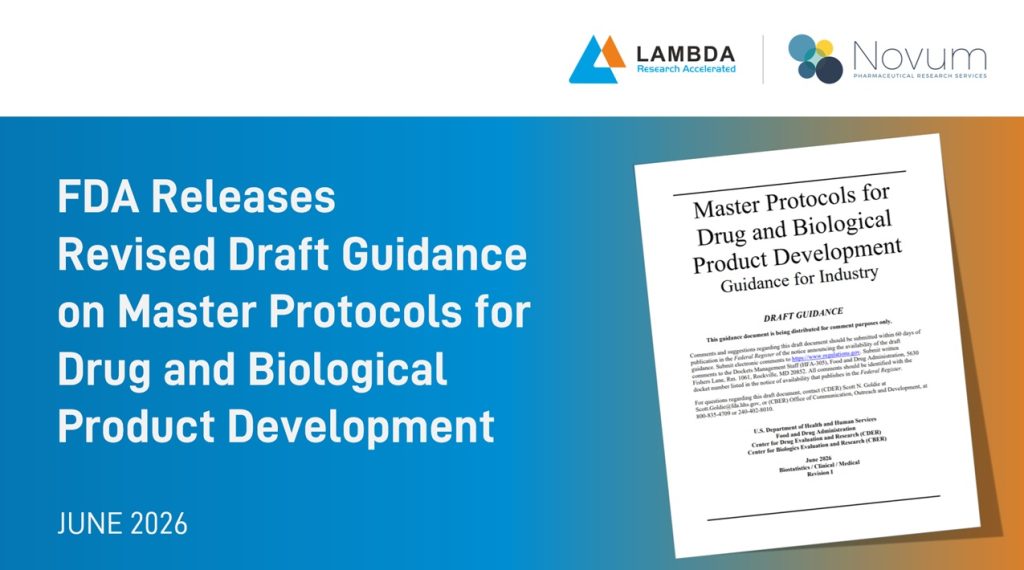
The FDA’s revised draft guidance on Master Protocols for Drug and Biological Product Development introduces updated recommendations for umbrella, basket, and platform trials, reflecting the growing role of innovative clinical trial designs in modern drug development.
The U.S. Food and Drug Administration (FDA) has released a revised draft guidance titled “Master Protocols for Drug and Biological Product Development,” providing updated recommendations on the design, conduct, analysis, and regulatory submission of clinical trials conducted under a master protocol. The revised document replaces the draft guidance published in December 2023 and incorporates feedback received during the previous public consultation. Public comments on the latest draft are being accepted until 24 August 2026.
As drug development becomes increasingly focused on precision medicine, targeted therapies, and complex clinical research programs, master protocols are gaining wider adoption as a means to evaluate multiple investigational products, indications, or patient populations within a single overarching trial framework. The FDA’s updated guidance aims to provide greater clarity on the Agency’s current expectations while supporting scientifically rigorous and efficient clinical development.
What Is a Master Protocol?
A master protocol is a single clinical trial protocol that enables multiple related studies, or sub-studies, to be conducted under a shared infrastructure. Instead of running several independent trials, sponsors can evaluate multiple research questions within one coordinated framework, using common operational procedures and governance.
The FDA guidance discusses three primary types of master protocols:
- Basket trials, which evaluate a single investigational therapy across multiple diseases, conditions, or disease subtypes sharing a common biological characteristic.
- Umbrella trials, which assess multiple investigational therapies within a single disease, often assigning treatments based on biomarkers or patient characteristics.
- Platform trials, which use an adaptive framework that allows treatment arms to be added or removed over time as new evidence becomes available.
Why Master Protocols Are Important
According to the FDA, well-designed master protocols can improve development efficiency by reducing duplication across multiple clinical trials. Shared infrastructure, standardized procedures, and centralized oversight can help streamline trial execution while maximizing the amount of information generated from a single research program.
Potential advantages include:
- Shared clinical sites and operational infrastructure
- Common visit schedules and assessment procedures
- Centralized randomization and data management systems
- Shared oversight committees
- Reduced duplication across multiple studies
- Opportunities to evaluate multiple therapies or patient populations more efficiently
These efficiencies may help accelerate clinical development while making more effective use of clinical research resources.
Key Areas Addressed in the Revised Guidance
The revised draft guidance provides recommendations across several important aspects of trial design and conduct, including:
- Randomization
- Selection of control groups
- Informed consent
- Blinding of treatment assignments
- Adaptive trial designs
- Comparisons between investigational therapies
- Evaluation of treatment effects across multiple diseases or disease subtypes
- Statistical considerations, including multiplicity
- Safety monitoring
- Trial oversight
- Data sharing and dissemination of information
- Regulatory submissions supporting product review
The FDA notes that although the guidance primarily focuses on randomized trials intended to provide substantial evidence of effectiveness and safety, many of the principles may also be useful for early-phase, exploratory, and certain post-marketing studies conducted under a master protocol.
What’s New in the 2026 Revision?
The revised draft guidance expands on several topics raised during the public comment period for the 2023 draft.
One of the most significant updates is the inclusion of more detailed recommendations for basket trials, providing additional clarity on their design and implementation. The document also includes refinements related to randomization strategies, control group selection, informed consent, and other areas to improve consistency and facilitate regulatory review.
Regulatory Context
The updated draft guidance also supports implementation of provisions within the Food and Drug Omnibus Reform Act of 2022 (FDORA), which called for recommendations to facilitate efficient clinical trial designs while maintaining participant safety, data integrity, and robust evidence generation.
As with all FDA draft guidances, the document represents the Agency’s current thinking and does not establish legally binding requirements. Sponsors may use alternative approaches, provided they comply with applicable statutory and regulatory requirements.
Looking Ahead
The revised draft guidance reflects the growing role of innovative clinical trial designs in modern drug and biologics development. As master protocols continue to support precision medicine, adaptive development strategies, and multi-arm clinical research, the guidance provides sponsors with a clearer regulatory framework for designing and conducting these increasingly complex studies.
Stakeholders interested in contributing feedback have until 24 August 2026 to submit comments before the FDA begins work on the final guidance
About Lambda: Lambda Therapeutic Research is a leading full-service Global Clinical Research Organization (CRO) headquartered in Ahmedabad (India), with facilities and operations in Mehsana (India), Las Vegas (USA), Toronto (Canada), London (UK), Barcelona (Spain), and Warsaw (Poland). Lambda provides comprehensive end-to-end clinical research services to the global innovator, biotech, and generic pharmaceutical industries.