

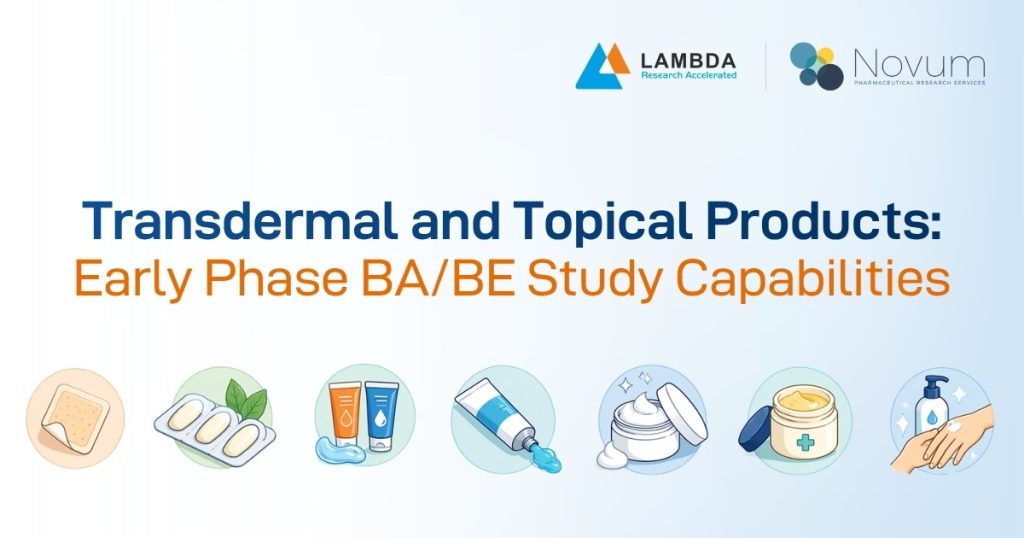
Transdermal and topical drug products present a distinct set of clinical and regulatory considerations in bioavailability and bioequivalence studies. These dosage forms require careful control of application, measurement, and evaluation to ensure reliable and reproducible outcomes.
Understanding Transdermal and Topical Products
Topical formulations such as creams, ointments, gels, lotions, and pastes are designed for localized action on the skin. In contrast, transdermal systems, typically patches, deliver the drug across the skin into systemic circulation.
Commonly studied molecules include Lidocaine, Diazepam, Progesterone, Estradiol, Nordoxepin, Nitroglycerin, Nicotine, and Rivastigmine. Additional experience includes Dapsone, Diclofenac Sodium, Midostaurin, Nintedanib, Levothyroxine Sodium, Doxepin HCl, Ibuprofen, and Estradiol.
Transdermal and topical delivery systems address several limitations of oral therapies. They avoid first-pass metabolism and provide controlled, steady drug release. This supports more stable plasma concentrations for systemic therapies and sustained local exposure for dermatological conditions. These formats are non-invasive and generally improve patient compliance.
At the same time, these products present formulation and clinical challenges. Drug permeation depends on the skin barrier and the application site. Some molecules are unsuitable due to hypersensitivity or inadequate permeability. Skin irritation and sensitization remain key risks. Adhesion variability in patches and formulation stability can impact both safety and efficacy. Regulatory expectations require robust, well-controlled clinical data across these parameters.
Integrated Clinical Study Approach
BA/BE studies for transdermal and topical products are designed to evaluate both systemic exposure and local tolerability. Lambda conducts integrated studies combining pharmacokinetics, adhesion assessment, and dermal safety evaluation, supported by trained clinical research teams and standardized procedures.
End-to-end study execution spans protocol design, clinical conduct, bioanalysis, statistical evaluation, and report submission, ensuring consistency across all phases.
Pharmacokinetic Evaluation
Pharmacokinetic endpoints remain central to demonstrating bioequivalence, particularly for transdermal systems with systemic delivery. Standard parameters include:
- Cmax, representing peak plasma concentration
- AUC (0 to t), reflecting exposure up to the last measurable time point
- AUC0 to infinity, representing total systemic exposure
Adhesion Studies
Patch adhesion is a critical quality attribute and a regulatory requirement. Studies are designed using statistical non-inferiority methods to confirm that the test product performs comparably to the reference in maintaining adhesion throughout the labeled wear period.
Adhesion is assessed at predefined intervals, typically every 12 or 24 hours. The standardized 5-point FDA scale is used to estimate the percentage of the patch remaining attached to the skin. Consistent adhesion is essential to ensure reliable drug delivery.
Skin Irritation and Sensitization Assessment
Dermal safety evaluation follows a structured, multi-phase design. Skin irritation is an immediate inflammatory response, while sensitization is a delayed immune reaction requiring prior exposure.
Dermal safety evaluation follows a structured, multi-phase design. Skin irritation is an immediate inflammatory response, while sensitization is a delayed immune reaction requiring prior exposure.
The study design includes:
- Induction phase lasting 21 days with repeated applications
- Rest phase of 14 to 17 days to allow resolution and immune response development
- Challenge phase with a single re-application for 48 hours at a new site
- Re-challenge phase conducted 4 to 8 weeks after the initial challenge
Skin responses are evaluated using validated scoring systems such as the Berger or Bowman scale. The Mean Irritation Score is used as the primary endpoint for comparison between test and reference products. Sensitization analysis focuses on demonstrating that the proportion of sensitized subjects is not higher for the test product.
Dosing Accuracy and Application Control
Topical dosing requires precise manual handling. Each dose is measured using an analytical balance. The investigational product is transferred using a syringe or weighing boat, followed by back-weighing to confirm the exact quantity applied.
Uniformity of application is controlled through detailed procedures. Dosing manuals specify application techniques, including the number of strokes or duration of spreading. This ensures that both test and reference products are applied in an identical manner.
Application sites are protected after dosing to prevent smearing or accidental removal, which could affect exposure and study outcomes.
Controlled Application Techniques
Standardization of application is critical for reproducibility. Defined methods are used to ensure consistent spreading of the product across all subjects.
Site demarcation is performed using templates or markers to define a fixed area, typically 2 by 2 cm, on the forearm or back. This prevents dose spreading beyond the intended site.
Application techniques are standardized, for example, 20 circular strokes or a defined duration such as 30 seconds, ensuring uniform coverage.
Quality Control Measures
Strict controls are implemented at every stage of study conduct. These controls reduce variability and support reliable data generation.
| Dispensing: |
| Dispensing is performed using calibrated analytical balances with back-weighing verification |
| Site Preparation: |
| Skin preparation ensures the site is clean, dry, and hair-free, with clipping instead of shaving to avoid micro-injury |
| Application: |
| Use of templates for surface area; standardized rubbing time/motion. |
| Monitoring: |
| Direct supervision to ensure subjects don’t touch or scratch the sites. |
A typical early phase BA/BE study follows a structured sequence:
Clinical Trial Protocol Flow
Screening & eligibility assessment
Review inclusion/exclusion criteria, medical history, and informed consent
Check-in & enrollment
Participant registration, randomisation, and study site admission
Baseline evaluations
Pre-dose vitals, labs, ECG, and validated clinical assessments
Supervised dosing
Investigational product administration under direct clinical supervision
Pharmacokinetic sampling & safety monitoring
Serial blood draws for pharmacokinetics; continuous adverse event surveillance
Check-out
Discharge assessments, concomitant medication review, and participant release
Washout period
Interval for drug elimination; no investigational product administered
Crossover phase(where applicable)
Participants switch to alternate treatment arm; repeat check-in through check-out for the alternate period
Study completion & final report submission
End-of-study visit, data lock, statistical analysis, and regulatory submission
Why Lambda?
Lambda brings established experience in transdermal and topical BA/BE studies across multiple dosage forms, supported by trained clinical teams, controlled application processes, and integrated bioanalytical capabilities. The team has worked across a wide range of molecules including Lidocaine, Diazepam, Progesterone, Estradiol, Nitroglycerin, Nicotine, Rivastigmine, Dapsone, Diclofenac Sodium, Midostaurin, Nintedanib, Levothyroxine Sodium, Doxepin HCl, and Ibuprofen.
The approach focuses on consistent study conduct, alignment with regulatory expectations, and generation of reproducible data, supporting early phase development of transdermal and topical products.
About Lambda Therapeutic Research
Lambda delivers comprehensive, end-to-end clinical research services to the innovator, biotech, and generic pharmaceutical industries worldwide. With a global presence across India, the USA, Canada, the UK, Spain, and Poland, Lambda brings specialized expertise to every project.
Lambda provides integrated capabilities for efficient execution of BA/BE studies aligned with global regulatory expectations. With experience of over 8000 studies across diverse dosage forms, Lambda offers established expertise and operational reliability. A well-established infrastructure and experienced teams enable efficient subject recruitment, screening, and study conduct. Lambda has experience across a wide range of oral dosage forms and follows structured workflows to support timely study initiation and execution.
Lambda has experience supporting submissions to the US FDA, EMA, and other global regulatory agencies, with a strong understanding of CDSCO requirements, including the prior intimation pathway. An integrated approach across clinical, bioanalytical, and data management functions ensures seamless execution, with end-to-end support from study planning to final report generation, while maintaining timelines without compromising data quality.
Connect with our experts at BD@lambda-cro.com to leverage our end-to-end capabilities.